Superhood
A neighborhood app has to feel like a neighbor, not a network. I led the design and the illustration identity of a local platform that the City of Helsinki later put into four of its districts.
- Client
- Superhood, Helsinki
- Role
- Design Lead, Semas Studio
- Years
- 2018 to 2021
- Outcome
- City of Helsinki pilot, 2023. Live in 63 cities
Superhood brings a neighborhood's news and information into one local feed, where residents, local businesses and the city publish to the same place, without tracking, closed groups or engagement algorithms. Its founder, Markku Mehtälä, brought the studio in at the start, and the design work ran from 2018 to 2021.
The brief inside that mission: a social app that deliberately refuses the mechanics social apps run on. With no algorithmic feed to do the work of feeling alive, the interface itself had to carry the warmth.
The illustration does the work the algorithm refuses
A feed without an engagement algorithm has a coldness problem: on a slow day in a small neighborhood, there is simply less to show. The design answers with an illustration identity, warm human characters drawn in one consistent style, placed exactly where the product is at its emptiest: onboarding, empty states, invitations, banners. Where a growth-driven app fills silence with recommendations, this one fills it with a drawn neighbor.
Every banner says what kind of message it is
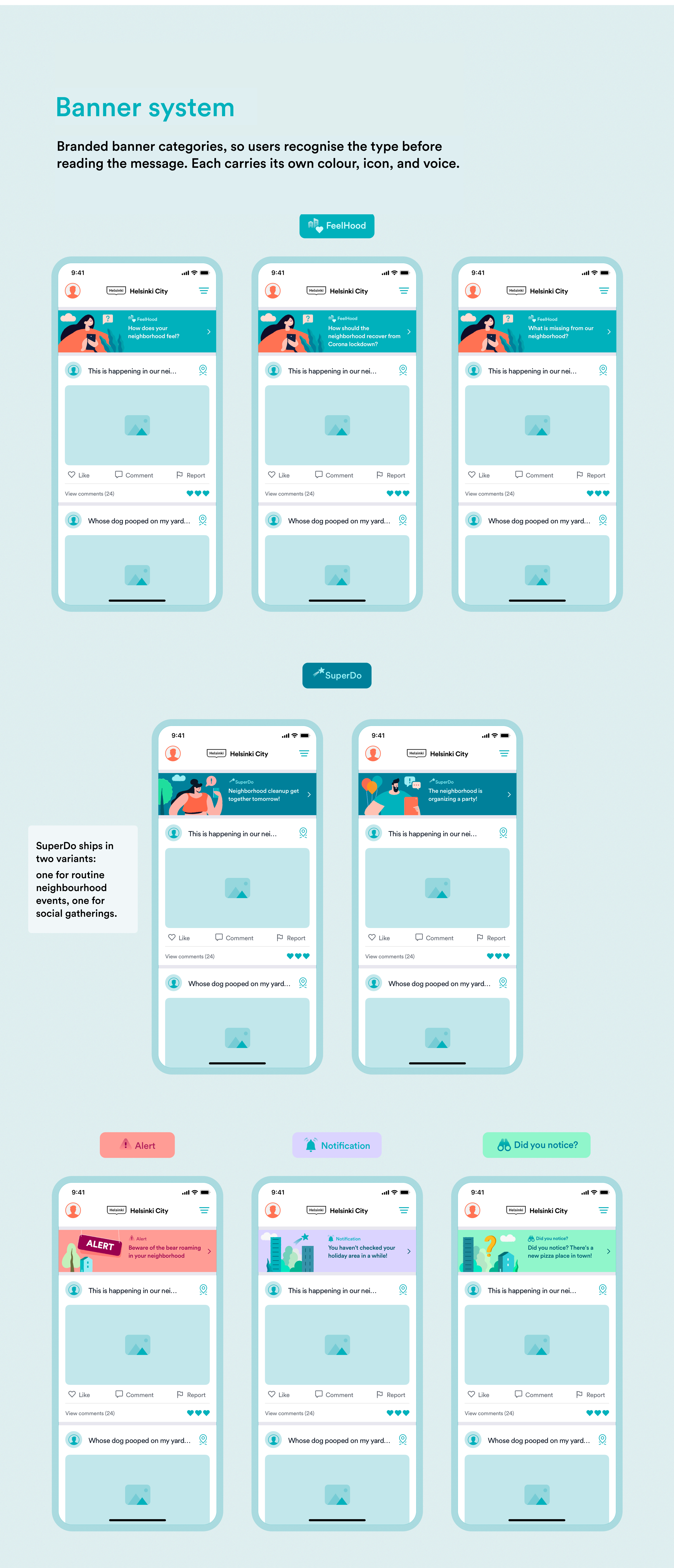
Banners are sorted into branded categories, so a resident recognizes the type of message before reading it. Each category carries its own color, icon and voice. FeelHood asks how the neighborhood is doing. SuperDo ships in two variants, one for routine neighborhood events and one for social gatherings. Alert, Notification and Did you notice sit outside the branded pair, because they carry system messages, not community ones.
Read first, register later
The welcome screen says it in one line: you do not need an account to use Superhood. For a product whose promise is no tracking, the front door had to prove the promise. A resident can connect a neighborhood, or draw their own on a map, and read the local feed before the app asks for anything. Identity comes later, when the person wants to speak rather than listen.
Many feeds were designed so one could ship
The feed was the most iterated surface of the engagement: variations in density, in how discussions fold under posts, in how much of the neighborhood's identity frames the stream. The shipped feed keeps the frame light, a dated day header, discussions collapsed to a count, hearts as the single reaction, so the neighbor's words stay the loudest thing on screen. Local businesses get a dedicated place in the feed, clearly marked as theirs. A community app that disguises ads as neighbors spends its only currency. One that marks them honestly turns the ad back into what a noticeboard always was: local information.
Posting, end to end
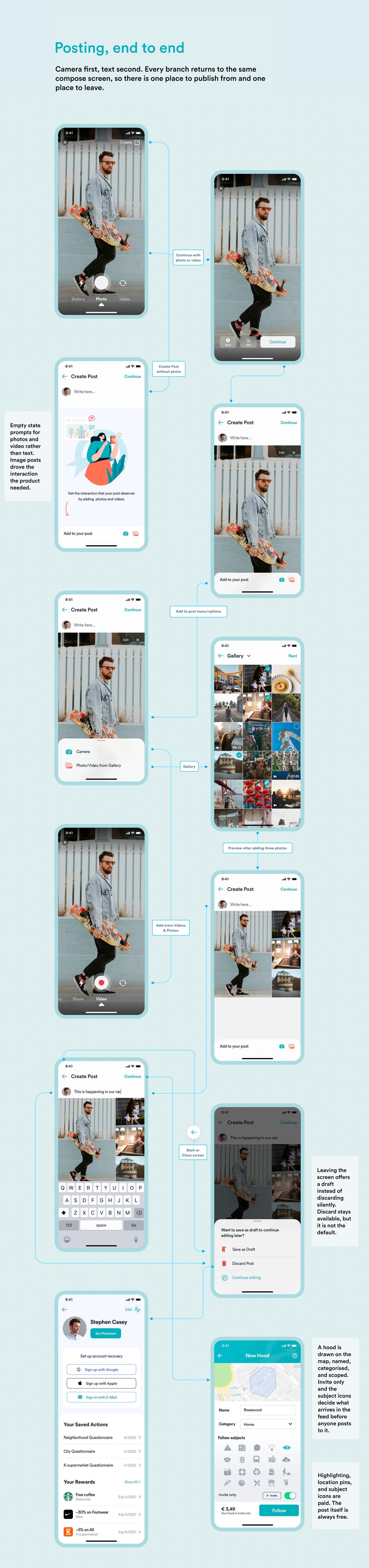
Camera first, text second. Every branch of the posting flow returns to the same compose screen, so there is one place to publish from and one place to leave. The empty compose screen asks for photos and video rather than text, because image posts drove the interaction the product needed. Leaving offers a draft instead of discarding silently. And a new hood is drawn on the map, named, categorized and scoped, so the rules of a neighborhood are set before anyone posts to it.
Reporting should be deliberate, and feel registered
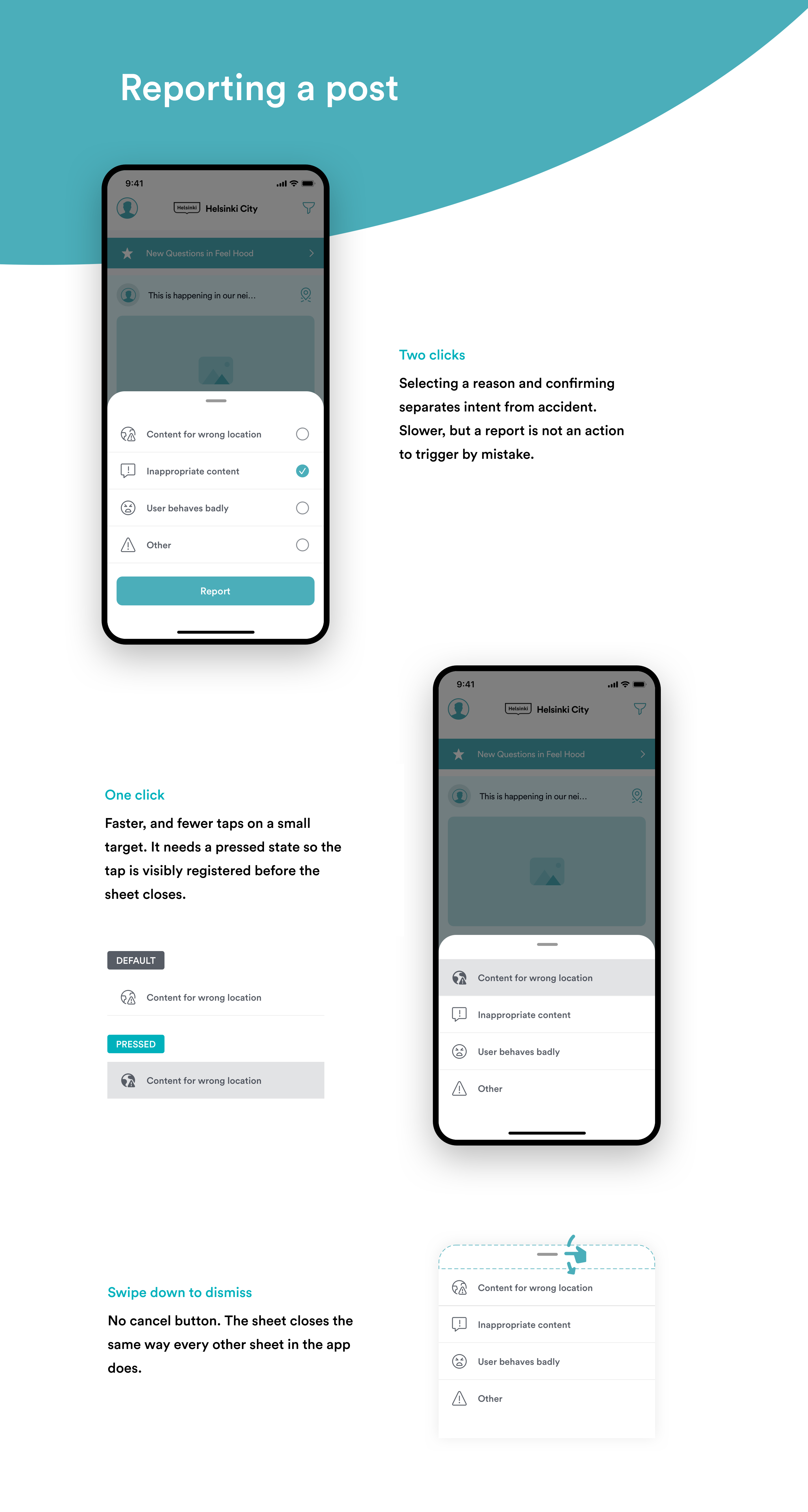
Two versions of the report sheet were set side by side. Two taps, choosing a reason and then confirming, separate intent from accident: slower, but a report is not something to trigger by mistake. One tap is faster on a small target, and needs a pressed state so the tap is visibly registered before the sheet closes. Either way there is no cancel button: the sheet closes with a swipe down, the same way every other sheet in the app does.
The typeface was corrected for small sizes
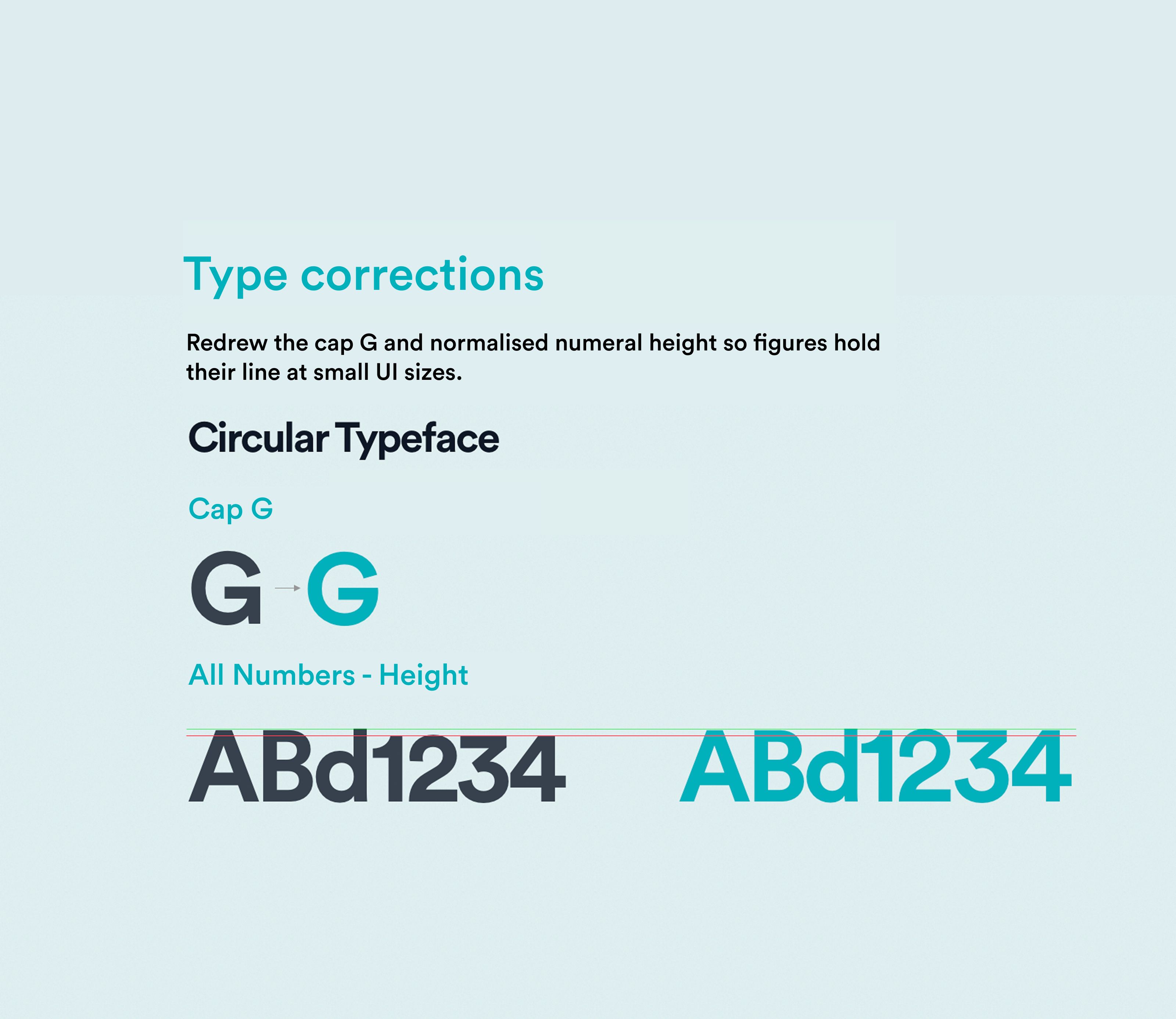
The brand typeface, Circular, carried the interface. Two details did not hold at small UI sizes, so they were redrawn: the capital G, and the height of the numerals, normalized so figures sit on their line next to letters.
Outcome
In 2023 the City of Helsinki selected Superhood through an open call and put it into four of its districts, Malminkartano-Kannelmäki, Mellunkylä, Lauttasaari and Kamppi, inside Circular Green Blocks, an EU-funded sustainability program run by the regional environmental authority with the city's innovation company and two Finnish universities.
The pilot was not the peak. Superhood is live in 63 cities across Finland and Germany, still carrying the same promise on its front page: no mandatory registration, no closed groups, no tracking.